Singh Process Servers India – Experts in Hague Service India
info@singhserve.comHague Service India has experience and expertise in service of legal documents in India.
Speak to an expert today
Tell us how we can be of service and one of our team members will contact you.
WhatsApp UsSingh Process Servers India has years of experience and proven expertise in the service of judicial and extrajudicial documents through the Hague Service Convention as well as private process service. We offer end-to-end guidance to ensure smooth and effective service in India. We assist clients throughout the Hague Service India process for a fixed consultancy fee of USD 200, providing clarity and confidence at every stage. Service of documents in India is often slow, procedural, and unpredictable. Even minor deficiencies in documentation can cause the process to stall indefinitely. Additionally, there is no formal tracking mechanism to determine where the documents are pending or the reason for delay, making it difficult for litigants and law firms to monitor progress. Our expertise helps prevent such setbacks by ensuring accurate documentation, proper compliance with Convention requirements, and strategic follow-ups with the concerned authorities. If you require reliable assistance for the service of documents through the Hague Convention, we invite you to contact us for professional support and timely guidance.
Hague Service India
This webpage contains information about Hague Service India i.e. regarding service of judicial and extrajudicial documents, which are issued by foreign courts and need to be served in India. The party to whom the documents need to be served could be an individual living in India (permanently or temporarily) or a corporation based in India. When you initiate legal proceedings in a country which is a member of the multi-national treaty named “Hague Convention on the Service Abroad of Judicial and Extrajudicial Documents in Civil and Commercial Matters” you are supposed to follow the provisions of this treaty as India is also one of the members of the treaty. The Convention applies only to civil or commercial matters where there is occasion to transmit a judicial or extrajudicial document “for service abroad” and the address of the person is known.
According to Article 52 of the Hague Convention, member states are required to designate an agency which shall be termed as Central Authority. This agency will be responsible for inbound and outbound service of documents in legal matters, as per the rules mentioned in the Hague Convention. Accordingly, the Indian Government has designated the below agency as Central Authority for Hague Service India:
The Ministry of Law and Justice
Department of Legal Affairs
Room No. 439-A, 4th Floor
A-Wing, Shastri Bhavan
New Delhi, 110001 India
At present, the Hague Convention has 84 contracting States and service of documents from one contracting state to other is governed by the provisions of this treaty. The treaty establishes a structured framework for cross-border document service. To check the complete list of signatories to Hague Treaty, click on the below button:
The documents need to be submitted to the Central Authority along with proper documentation, to initiate Hague Service India. The Central Authority will then forward the documents to the relevant jurisdiction for service. Upon completion, the Central Authority issues a certificate detailing the service under Article 63. The whole process can take a time of around six months to one year.
Though the Hague Convention permits various service methods such as postal channels, diplomatic channels, judicial officers, diplomatic or consular agents and private individuals. However, the receiving State may object to any of these methods. In this context, the “requesting State” refers to the jurisdiction where the request for service originates and the “receiving State” is where the documents are to be served. For example, if an action is initiated in the US against a party based in India, the US would be the requesting State and India would be the receiving State.
Government’s approach to the Hague Service India is restrictive, keeping aside the Convention’s intent to promote flexibility in cross-border service. India categorically objects to all Article 10 provisions, prohibiting service via post, judicial officers and private individuals. Further, India also restricts service through diplomatic or consular agents unless the addressee is a national of the requesting State. Consequently, India recognises no direct service methods that bypass its Central Authority mechanism. This means that foreign parties must affect service exclusively through India’s Central Authority. While the Convention prescribes procedural details, Indian courts execute service requests under domestic law. The Department of Legal Affairs transmits documents to the appropriate District Courts for service execution as per the Civil Procedure Code of India. After service completion, courts return proof of service to the Central Authority, which then issues a certificate. Administrative backlogs often delay this process. Moreover, no digital infrastructure exists for submitting or tracking service requests.
As mentioned on the official website of Ministry of External Affairs:
India is a signatory to the Hague Convention on the Service Abroad of Judicial and Extra-Judicial documents in Civil and Commercial Matters. Therefore, the formal method for service in India with effect from August 1, 2007 is pursuant to the Hague Convention, taking into account the declaration or special conditions mentioned by India in while signing the Hague Convention. The declarations made by India while signing the Convention include the following:
– Documents for service must be written in the English language.
– Documents cannot be served via mail.
– Documents must be served in India indirectly via proper authority.
– Documents under the Hague Convention cannot be served directly to the defendants in India by private judicial officer.
Country Specific Variations
The Convention does not operate identically in all jurisdictions. In essence, membership in the Hague Service Convention does not mean blanket acceptance of every service method. Contracting States retain the right to:
– Reject specific modes of service
– Impose procedural safeguards
– Limit the Convention’s operation within their territory
Therefore, any attempt at international service of process must examine the receiving country’s reservations and declarations, failing which the service may be legally ineffective. A method of service valid in one country may be invalid in another country.
1. Declarations
Declarations allow a Contracting State to clarify how it will implement specific provisions of the Convention. These usually concern:
- Designation of Central Authorities
- Acceptable languages for documents
- Procedural conditions under Articles 5, 15, and 16
- Time limits for relief from default judgments
Declarations do not reject the Convention but define its operational scope within the declaring State.
2. Reservations and Objections
Certain articles expressly permit States to oppose or opt out of particular service methods. This is most significant in relation to alternative service channels.
Article 10 (Most Common Opt-Out)
Article 10 allows service through:
– Postal channels
– Judicial officers
– Direct communication between competent persons
However, this applies only if the receiving State does not object.
Many countries, including Singapore, China, Germany (earlier), and others, have formally objected to Article 10. In such countries:
– Service by post or courier is invalid
– Only Central Authority service is legally recognized
Article 8
Article 8 allows service through diplomatic or consular agents. Several countries restrict this method or allow it only where the recipient is a national of the sending State.
Articles 15 and 16
These articles deal with:
– Passing of judgments in absence of proof of service
– Relief from default judgments
States may declare:
– Maximum time limits for seeking relief
– Conditions under which courts may proceed without service certificates
– This directly affects enforceability of foreign judgments.
Indian Courts View on Hague Service India
Many foreign courts (e.g. US federal courts) sometimes authorise alternative service (email, post etc.) when Hague service proves slow; whether such service suffices for recognition/ enforcement in India remains a contestable issue.
Indian courts acknowledge that Hague Convention is binding where applicable and they lean towards treating it as mandatory default. Courts have repeatedly stressed that you cannot use the Civil Procedure Code (CPC) to evade the Convention in a case where it clearly applies. Where India and the foreign state are parties to the Hague Service Convention, Indian courts treat the Convention as the primary and generally mandatory framework for service abroad and service into India, with limited flexibility for alternate channels (e.g. postal service) only to the extent permitted by Article 10 and the reservations of both states and consistent with the CPC.
The Kerala High Court in Mollykutty vs. Nicey Jacob passed an order in a case where the summons to defendant whose address was at USA was sent by way of registered post, returned unclaimed and defendant was placed ex-parte. The High Court held that such summons was not justified and held that whenever service of notice/summons to the defendants residing in a foreign country comes for consideration, it is incumbent upon the Courts below to ascertain whether the country is a party to the Hague Convention and held that the summons was not sent in adherence to the rules of procedure of the Hague Convention and it was sent directly to the appellant by registered post and arrived at a conclusion that the summons was not duly sent and there was no circumstance to declare deemed.
Private Service Challenged in India
In Anupama Sharma v. Union of India, the summons issued by the New York Court was privately delivered to the Petitioner in the proceedings which were pending before the New York Court. The petitioner contended that the service of summons was contrary to Article 3 and 5 of the Hague Convention since the summons was served not by the U.S. Court to the Indian Government but privately delivered. The Petitioner also submitted that India had specifically opposed Article 10 of the said Convention, which permits service of summons or judicial documents by postal channels directly to the persons staying abroad. However, the Bombay High Court observed that it will not be possible for it to stay the service of summons while exercising its writ jurisdiction under Article 226 of the Constitution of India and the petitioner can take the said objection before the New York Court and if her contention is right, the New York Court may ask the respondent to serve the summons again, in terms of the provisions laid down under Article 3 and 5 of the Convention.
Recent Example
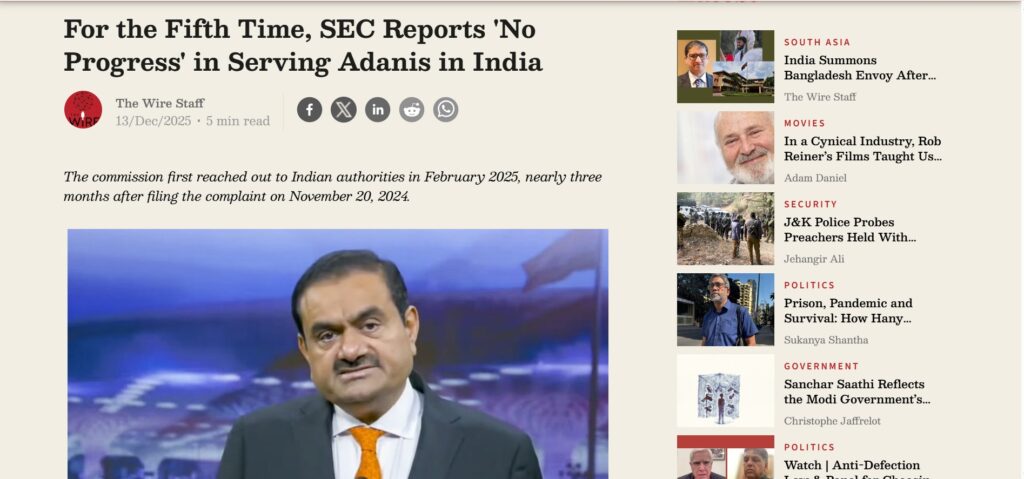
The U.S. Securities and Exchange Commission (SEC) informed a New York court on February 18, 2025, that it has sought assistance from the Indian government under the Hague Service Convention—formally known as the Convention on the Service Abroad of Judicial and Extrajudicial Documents in Civil or Commercial Matters, 1965—to serve summons on billionaire Gautam Adani and his nephew Sagar Adani in a securities and wire fraud case. The Indian Law Ministry requested an Ahmedabad court to serve the summons on Gautam Adani under the Hague Service Convention, rather than allowing direct service from the U.S. authorities, illustrating that the Indian government expects foreign process into India to follow the Convention route, not private or direct service. Even after 10 months, the documents could not be served in such an important and international matter.